
Why Stretching Isn’t Fixing Your Tight Hips
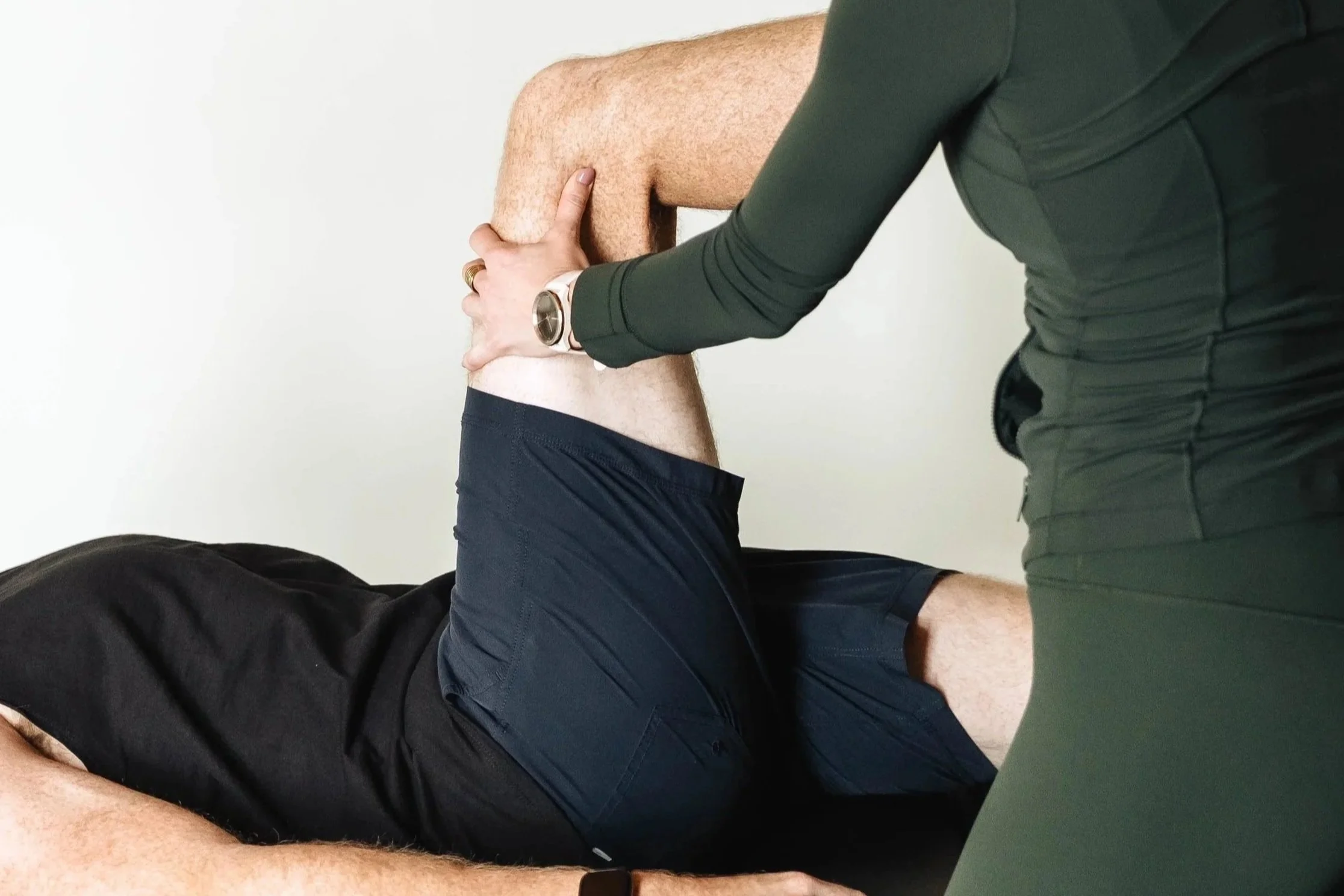
Is Your Hip Tightness Actually a Strength Problem?
If your hips always feel tight, no matter how much you stretch, you’re not alone.
Most of the people I work with come in saying the same thing:
“I stretch all the time, but it never lasts.”
This is what tends to surprise people. It might not be a flexibility issue at all. At Physique Health Studio in San Diego, I often see clients dealing with chronic hip tightness that stretching alone doesn’t resolve.
I’ve Been There Too
I’ve experienced this myself, and not in a vague way.
I have a history of right hip subluxation with a small labral injury, and for a long time my symptoms showed up as persistent tightness through the front and pain into into side of my hip.
Naturally, I treated it like a tissue problem.
I was consistently working on my psoas and TFL.
Dry needling, active tissue release, stretching, even lying over a lacrosse ball trying to get the tissues to release.
And to be fair, it worked. Temporarily.
I could reduce the tension, get some relief, and feel better for a bit.
But it always came back.
What Most People Get Wrong
Here’s what most people don’t realize:
Tightness is often your body asking for stability, not more stretching.
When your body doesn’t feel supported or controlled in a certain area, it will create tension as a protective response. That “tight” feeling isn’t random. It’s your body trying to keep you safe.
Tightness can also be a sign your body is craving better awareness and control.
If your brain doesn’t have a clear sense of where your hips are in space, it will often default to creating stiffness to find stability.
More stretching doesn’t fix that. Better control and awareness does.
What Was Actually Happening (In My Case)
When I look back at it now, it wasn’t just that my TFL or psoas were “tight.”
My system was biased toward using those structures.
The TFL does contribute to hip flexion, abduction, and internal rotation.
And when it becomes dominant, it can subtly pull your hip into more internal rotation, especially during movement. And I knew my tight psoas was biasing my innominate into a forward rotation, compared to my left side.
But that doesn’t happen in isolation.
In my case, there was a lack of support from the posterior hip.
Especially the glute max and deep external rotators that help control rotation and stabilize the joint. And the weakness in my right hamstrings was not effectively counterbalancing my overactive psoas.
So instead of balanced control, my body relied more on anterior and lateral structures.
How That Affects the Rest of the Hip
When your femur sits in more internal rotation, especially under load like walking or single-leg work, the demand on surrounding musculature changes.
The deep hip rotators (like the piriformis) aren’t just stabilizing anymore.
They start working harder to control and decelerate that motion.
Over time, that can show up as:
Increased tone or sensitivity in the piriformis
Compression or irritation around the lateral/posterior hip
That familiar “tight” or restricted feeling that doesn’t fully go away
So this isn’t just about tight muscles.
It’s about how your body is managing load when you move. And right now, it’s not doing that well.
Why the Release Work Helped (But Didn’t Last)
This was the piece that really changed things for me.
The work I was doing, releasing the TFL/working into the piriformis, wasn’t wrong.
It was just incomplete.
What it was actually doing was temporarily changing the strategy my body was using:
Reducing tone in the TFL → less pull into internal rotation
Reducing tone in the posterior hip → less compression and irritation
Creating a short-term sense of relief and space
But because I hadn’t addressed the underlying strength and control piece,
my body went right back to the same pattern.
What Actually Helps
What creates real, lasting change is a different approach:
Building strength in the right areas (especially posterior hip support)
Improving control through rotation and single-leg movement
Developing better body awareness so your system doesn’t rely on tension for stability
This is where a more individualized, clinical approach makes all the difference.
Combining physical therapy with Pilates allows us to build strength, coordination, and control in a way that actually supports how your body moves.
What Changed for Me
Once I shifted away from constantly trying to release everything and started focusing on stabilization, motor control, and intrinsic strength (using a combination of Pilates and targeted strength work for my hamstrings, rotators, and hip extensors), things changed.
My hip stopped feeling like something I had to manage all the time.
The tightness didn’t just temporarily go away. It stopped showing up the same way.
If This Sounds Like You
If your hips always feel tight and nothing seems to stick,
it might be time to look at it from a different angle.
You don’t need to stretch more. You need a strategy that actually addresses what’s causing it.
If you want to figure out what’s really going on in your body,
you can reach out or book an evaluation. I’m always happy to help guide you in the right direction.
Who This Is For
You feel like your hips are always tight no matter what you do
You stretch regularly but don’t see lasting results
You’ve tried foam rolling, release work, or mobility routines with short-term relief
You want to understand your body, not just keep chasing symptoms